







Warner Brothers on YouTube has performed a great service to the world: It has posted multiple mega-compilations of Looney Tunes cartoons. Bugs Bunny. Daffy Duck. Porky Pig. Sylvester and Tweety Bird. They’re all there, along with Elmer Fudd and Yosemite Sam and a constantly shifting roster of special guests.
Talk about rabbit holes.
The number-one character, the greatest star, especially if you ask him, is a grey-and-white, long-eared rabbit (or hare) with a wisecracking personality and a serious carrot habit. Bugs Bunny first evolved in the 1930s; by 1940 he’d taken the form we all know and love. He was the second cartoon character to get a star on the Hollywood Walk of Fame, after Mickey Mouse, and like Mickey for Disney, he became the spokesbunny for Warner Brothers. He’s still going in multiple forms, from comic books to feature films to games and, of course, cartoon shorts on television.
Bugs is the epitome of cool. Very little fazes him. With carrot in hand, he’s always ready to deliver his signature line, “What’s up, Doc?”
Late-era Bugs lives in a regular house, but for decades he inhabited a rabbit hole, complete with mailbox with his name on. The hole can crop up anywhere. When he stops for the night in a remote mansion that turns out to belong to a group of gangsters, he drills a hole in the floor and makes himself comfortable.
Bugs’ original and frequent adversary is Elmer Fudd. Elmer takes various forms over the decades, but ur-Elmer is a hunter, and he wants you to be very, very quiet, because he’s hunting rabbits. Hunting is Elmer’s passion. He doesn’t even eat what he hunts. “I’m a vegetarian,” he says. “I hunt for sport.”
Bugs gives him all the sport he’ll ever want or need. So does Bugs’ best frenemy, Daffy Duck, who vies with him to convince Elmer that it’s hunting season for the other’s species. Rabbit season? Duck season? Poor Elmer collapses in confusion.
Confusion is the way of this world, and Bugs is the king of the tricksters. There are no rules that can’t be broken, except one: The rabbit always wins. He’s smarter than anybody else, and there’s no obstacle he can’t find a way around, over, under, or through—or that he can’t talk himself out of.
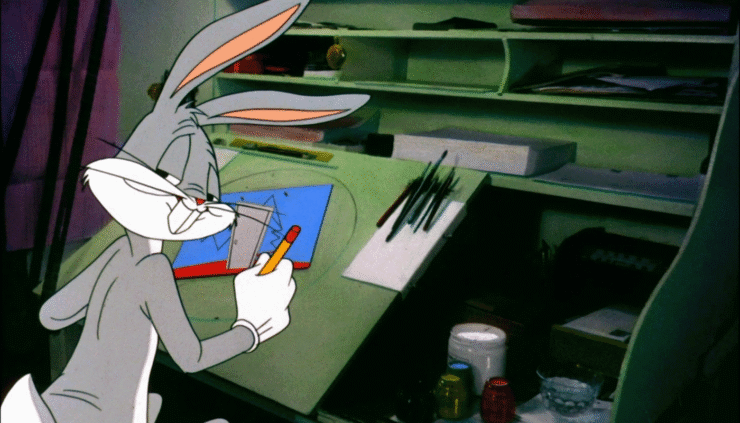
The only time he’s even close to flummoxed is when the fourth wall comes down and The Artist takes control. The moving finger writes, the pencil draws and then erases, and even Bugs’ ingenuity can’t stop The Artist from taking sometimes violent liberties.
That’s only fair, we learn, when we see who The Artist is: none other than Elmer Fudd. Finally, he says, I got even with that wascally wabbit.
But tomorrow is another day, and another cartoon, and Bugs is back, triumphant as ever. He extends across worlds. He steps in for the Roadrunner as the quarry for Wile E. Coyote, self-proclaimed Genius. He stars in takeoffs on the classics: “The Scarlet Pumpernickel.” “Mutiny on the Bunny.” “A Star Is Bored.” And to my mind the greatest of them all, “What’s Opera, Doc?”
Like all great comic characters, Bugs Bunny is more than a set of gags or a laugh line. He’s an archetype. No matter what you throw at him, he always has a comeback. You can’t beat him. You can’t even damage him—unlike his friend/rival/adversary, Daffy Duck, who all too often catches the flak that’s aimed at Bugs.
The heart of Bugs’ power is incongruity. Rabbits in myth and lore are timid and shy. They’re prey. They don’t hunt; they’re hunted. Nor are they known for their ability to outsmart their hunters. The one thing they really are good at is making more rabbits.
And here’s a rabbit who outsmarts everybody. Hunters can’t catch him. Predators can’t touch him. He’s afraid of nothing. He’s everything a rabbit is not supposed to be—but there he is. Long ears. Big teeth. Crunching his carrot. Cracking wise. Owning the world and everything in it.

IIRC one of the 50’s cartoons had Bugs lounging by the pool in his backyard, but I don’t recall if he had a house in that one.
In the mid-80’s when Yes was touring 90215 the opening “act” was “Water Water Every Hare”, so I actually got to see that one on the big screen.
If it’s the cartoon I’m thinking of, I think the idea was that Bugs Bunny, the famous actor who played himself in the Warner Bros. cartoons, was being interviewed out of character at the poolside of his celebrity mansion.
The Loony Toons characters are a USican pantheon of minor gods — Bugs is a Trickster, Daffy represents green, Elmer is a Fool, and so forth.
In one of the WW2 cartoons Bugs went up against another trickster, the Gremlin, and would have lost if the airplane hadn’t run out of gas on the way down… “You know how it is with those “A” cards.”
I think I probably needed my father to explain wartime fuel rationing to me before I understood that joke. And other rationing references in cartoons from the period, like the slogan “Is this trip really necessary?”
As defined by Chuck Jones, Daffy is more about ego and vanity than greed. Jones developed the characters’ mature personalities as we know them today, and he tended to define them by their fatal flaws. In Daffy’s case, his ambition and ego fatally exceed his competence, so he constantly bites off more than he can chew and brings disaster on himself. Although I suppose that is greed in a sense, his craving for success and approval.
Bugs is rare among Jones’s characters in that he’s a comic hero rather than a self-sabotaging goat like Daffy or Wile E. Coyote (who was meant to represent Jones’s own mechanical incompetence). He was always a trickster as initially developed by Tex Avery, but under Jones he was a benevolent trickster, going after his foes ruthlessly but only in defense of himself or of others who couldn’t defend themselves. (It’s similar to the evolution of the Marx Brothers between their early Paramount films where they were chaotic tricksters for its own sake to their later MGM films where they were more heroic and acted on behalf of the romantic leads.)
Jones considered his only other comic hero to be Pepe Le Pew, oddly enough; though Pepe is as delusional as Daffy about his appeal to the opposite sex (or even how to identify his preferred sex and species), Jones found him “heroic” in that he’s forever undaunted by his failures and keeps on optimistically trying (although from a modern perspective we call that sexual harassment).
It may be a personal thing, but I’ve never quite been able to reconcile the non-speaking Wile E. Coyote of the Roadrunner cartoons with the urbane, smooth-talking Wile E. who carries Super-Genius business cards and comes across as a gentleman rogue. The silent Wile E. is the physical embodiment of desperation and forlorn hope (see especially the texts of the signs he holds up when he needs words); the speaking character has a sense of style and self-assurance (and the ego to match) that’s almost entirely lacking in his voiceless twin.
Which leaves me wondering how they’re going to handle these divergent personalities in the upcoming Coyote v. Acme when that hits theaters later this summer. (If I had written the movie, I’d have made them twins, or at least cousins, though perhaps saving that revelation as a late-stage twist. And of course, having now seen Bugs himself in the trailer, we know that all bets are absolutely off where late-stage twists are concerned…)
Well, both versions of Wile E. were in Chuck Jones cartoons, so he adapted the character to his adversary. Pitting him against Bugs Bunny required giving him a voice and making it a battle of wits. Keep in mind that most of the characters adapt themselves to different personas in different cartoons. To an extent, they’re all actors playing roles, like how Buster Keaton or the Marx Brothers or Abbott & Costello adopted different character names and professions in different movies but were still recognizably themselves doing their familiar shticks. Usually Wile E. Coyote plays the role of the silent-film slapstick performer constantly trying and failing to catch the Road Runner, but a couple of times, he was cast in the speaking role of Wile E. Coyote, Super Genius, adversary to Bugs Bunny.
Although there was the 1962 TV pilot The Adventures of the Road Runner, directed by Chuck Jones, which included several new Coyote/Road Runner segments framed by Wile E. narrating in his Super Genius voice to a pair of child viewers including another Chuck Jones character, Ralph Phillips. That’s the one time the two versions of Wile E. were conflated. The pilot didn’t sell, but was edited into three segments that have often been shown as individual shorts.